

Author: Techub Hot News
Author: Yangz, Techub News
Unlike the gradual warming of the temperature in recent days, the cryptocurrency market has been declining since Bitcoin fell below $90,000 on February 25. At around 10:50 today, Bitcoin fell below the $80,000 mark, hitting a new low in nearly three and a half months. Coingalss data shows that in the past 24 hours, the total amount of liquidation in the entire network reached $728 million, of which long orders were about $621 million and short orders were about $107 million. In addition, according to Alternative.me data, although the cryptocurrency panic and greed index has rebounded from yesterday, it is still in an "extreme panic state."
However, in this panic-stricken market, a series of recent actions by US financial regulators suggest that their previous tough attitude towards cryptocurrencies is softening, and the hostile regulatory "ice" of the previous institutions is slowly melting.
The attitude of the new SEC
If the previous SEC, led by Gary Gensler, was hostile to the cryptocurrency industry, the new SEC's attitude can be described as positive. Since Gary Gensler officially stepped down on January 21, the new SEC, led by Acting Chairman Mark Uyeda, is working hard to change its image in people's minds.
In the past week, the US SEC has successively ended its investigation and enforcement actions against OpenSea, Robinhood Crypto, Uniswap Labs, and Gemini, and officially withdrew the lawsuit against Coinbase, and plans to withdraw the lawsuit against ConsenSys and MetaMask. In addition, Binance and the US SEC submitted a joint motion in the middle of this month, applying for a 60-day suspension of the lawsuit on the grounds that "the newly established cryptocurrency working group may have an impact on the case." This is the first time that a suspension request for cryptocurrency-related lawsuits has appeared since Mark Uyeda became acting chairman. Influenced by this, the Tron Foundation and Justin Sun also jointly submitted a joint motion to suspend the lawsuit with the US SEC.
In addition, regarding the controversial Memecoin, the US SEC has also changed its ambiguous attitude in the past and issued clear guidance, saying that it is "not a security, but similar to a collectible." The US SEC believes that transactions related to Memecoin do not involve the issuance and sale of securities stipulated by federal securities laws. Therefore, individuals involved in the issuance and sale of Memecoin do not need to register their transactions with the Commission under the Securities Act of 1933, nor do they need to comply with the registration exemption provisions in the Securities Act. Of course, the department also pointed out that buyers or holders of Memecoin are not protected by federal securities laws.
Perhaps it is because of the recent market downturn and the frequent signals released by the SEC that people have begun to notice the huge changes it has made. In fact, since the establishment of the new SEC, various actions have never stopped.
The day after Gary Gensler officially resigned, Mark Uyeda announced the establishment of a cryptocurrency task force, led by Hester Peirce, "dedicated to developing a comprehensive and clear regulatory framework for cryptocurrency assets." Then on January 24, the U.S. SEC officially revoked the crypto asset accounting standard SAB-121, which was the "first shot" of the comprehensive reform. Since then, the U.S. SEC has begun to reduce the size of the cryptocurrency enforcement department, transferred some lawyers and staff to other departments, and formed a new task force to announce ten major tasks such as examining the status of different types of crypto assets under securities laws and providing clear statements on the methods used to approve or disapprove crypto ETFs. Next, we saw various news about the U.S. SEC's review of ETFs, such as publicly soliciting comments on the Grayscale Litecoin ETF, accepting the 19b-4 application for the Grayscale Solana ETF, accepting the application for the Grayscale XRP Trust Conversion ETF, and accepting the 19b-4 application submitted by Cboe BZX to add a pledge function to the 21Shares Ethereum ETF.
All of this suggests that the new SEC will present a completely different image.
Other regulatory developments outside the US SEC
In addition to the US SEC's active reforms in cryptocurrency regulation, other regulatory developments are also worthy of attention.
The U.S. House of Representatives Ways and Means Committee recently passed a resolution to repeal the IRS "DeFi Broker Rule" by a vote of 26 to 16, which is a big boon for DeFi. It should be noted that the resolution still needs to be passed by a majority of the House of Representatives and the Senate and signed by the President before it can take effect.
In addition, at the first hearing of the U.S. Senate Banking Digital Assets Subcommittee chaired by Cynthia Lummis recently, the legislative progress on stablecoins became the focus. Lummis emphasized that stablecoins will be the subcommittee's top priority in the future and "plans to develop a bipartisan legislative framework for stablecoins and their market structure in the coming months." Former Commodity Futures Trading Commission (CFTC) Chairman Timothy Massad also suggested at the hearing that lawmakers should prioritize the legal framework for stablecoins and postpone issues related to market structure. In addition, Virginia Democrat Mark Warner asked panelists to discuss the possibility of KYC processes for stablecoin users.
At the same time, more and more government departments are accelerating their listening to the voices from the cryptocurrency industry. For example, US Treasury Secretary Scott Bessent recently hired Galaxy Digital legal counsel Tyler Williams as a digital asset and blockchain technology policy advisor. According to Michael Saylor, he recently met with French Hill, chairman of the US House Financial Services Committee, and proposed a set of digital asset regulatory framework recommendations to him.
These moves from governments, regulators and industry leaders all indicate that the regulatory environment in the cryptocurrency field is gradually maturing. Against this backdrop, although the current market is cold, from a long-term perspective, the cryptocurrency market may usher in a healthier and more standardized development period.
Beyond regulation, the progress of strategic Bitcoin reserves in various states
Different from the direct regulatory benefits released by the U.S. SEC and various agencies, although the progress of strategic Bitcoin reserves in various states has not been so smooth, it is still beneficial overall.
The " Bitcoin Laws " website established by Julian Fahrer shows that currently 24 states in the United States have proposed strategic Bitcoin reserve bills, with a total of 31 bills. Among them, the Bitcoin reserve bills in Montana, South Dakota, North Dakota, Pennsylvania and Wyoming have been rejected or shelved. The state with the fastest progress is Utah, and the relevant bill has been submitted to the Senate. The second is Arizona. The relevant bill passed the third reading of the Senate with 17 votes in favor and 12 votes against. It will now be submitted to the House of Representatives for deliberation. Other states with relatively advanced progress include Oklahoma and Texas. (Note: The bill can be introduced in the House of Representatives or the Senate. If it is introduced in the Senate, it will be submitted to the House of Representatives after the approval of the Senate, and vice versa. If passed by both houses, the bill will be submitted to the governor for signature to become law or vetoed. Once the governor signs, the bill becomes law)
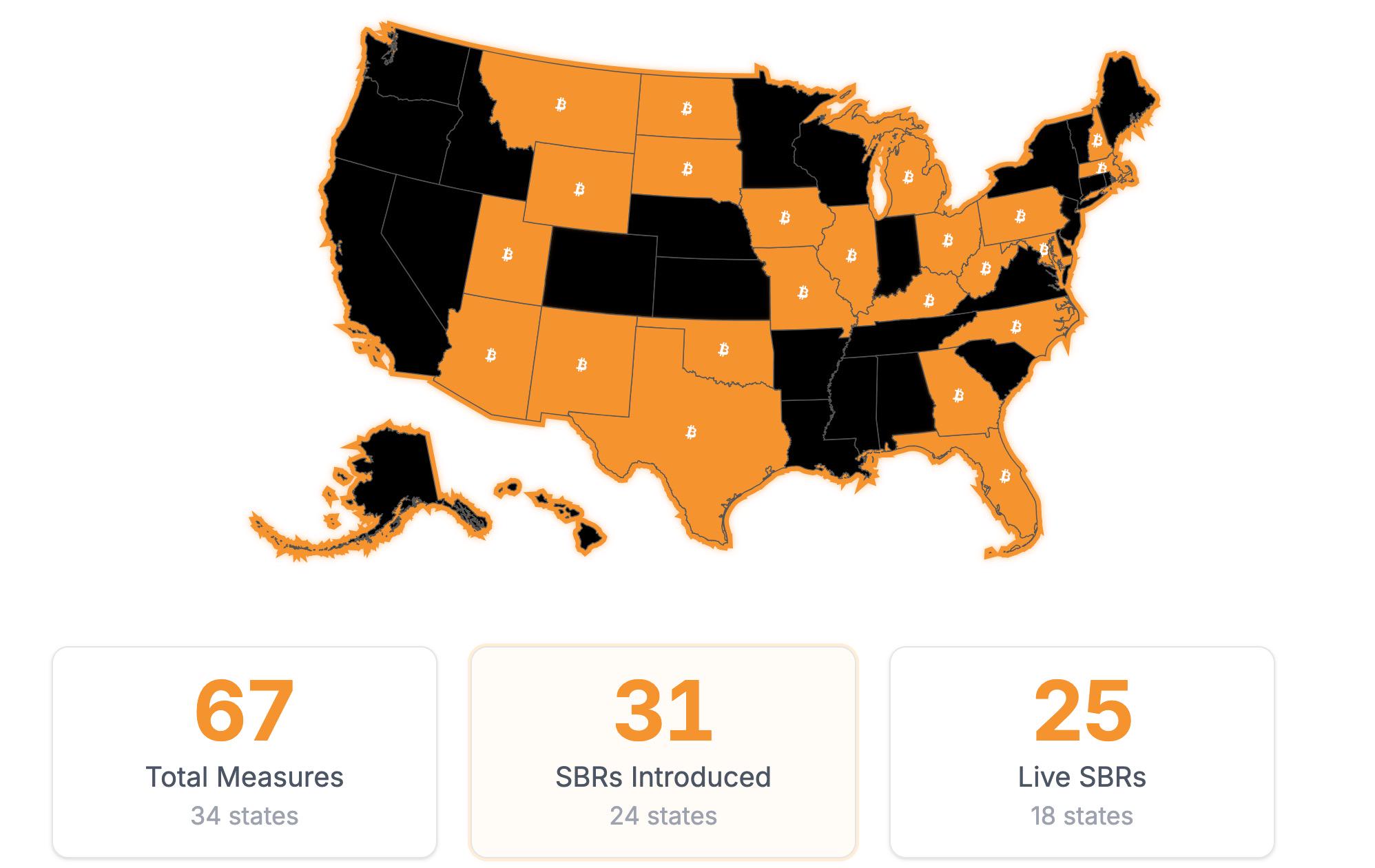
Although the pace of progress varies from state to state, the legislative progress of the strategic Bitcoin reserve indicates that local governments are paying attention to and adopting cryptocurrencies. Although it is unknown what the Trump administration is currently preparing for the strategy, it may be more reasonable not to rush into action.
summary
Although the market is facing drastic price fluctuations and the spread of panic under the largest hacker crisis in history, it is hoped that the gradual improvement of the regulatory environment will gradually melt the past regulatory "ice" like the warm breeze of spring, injecting new vitality into the market. As for the current declining market, the author also recommends that you wait and see.